Marine technology2026EN
Pelagion
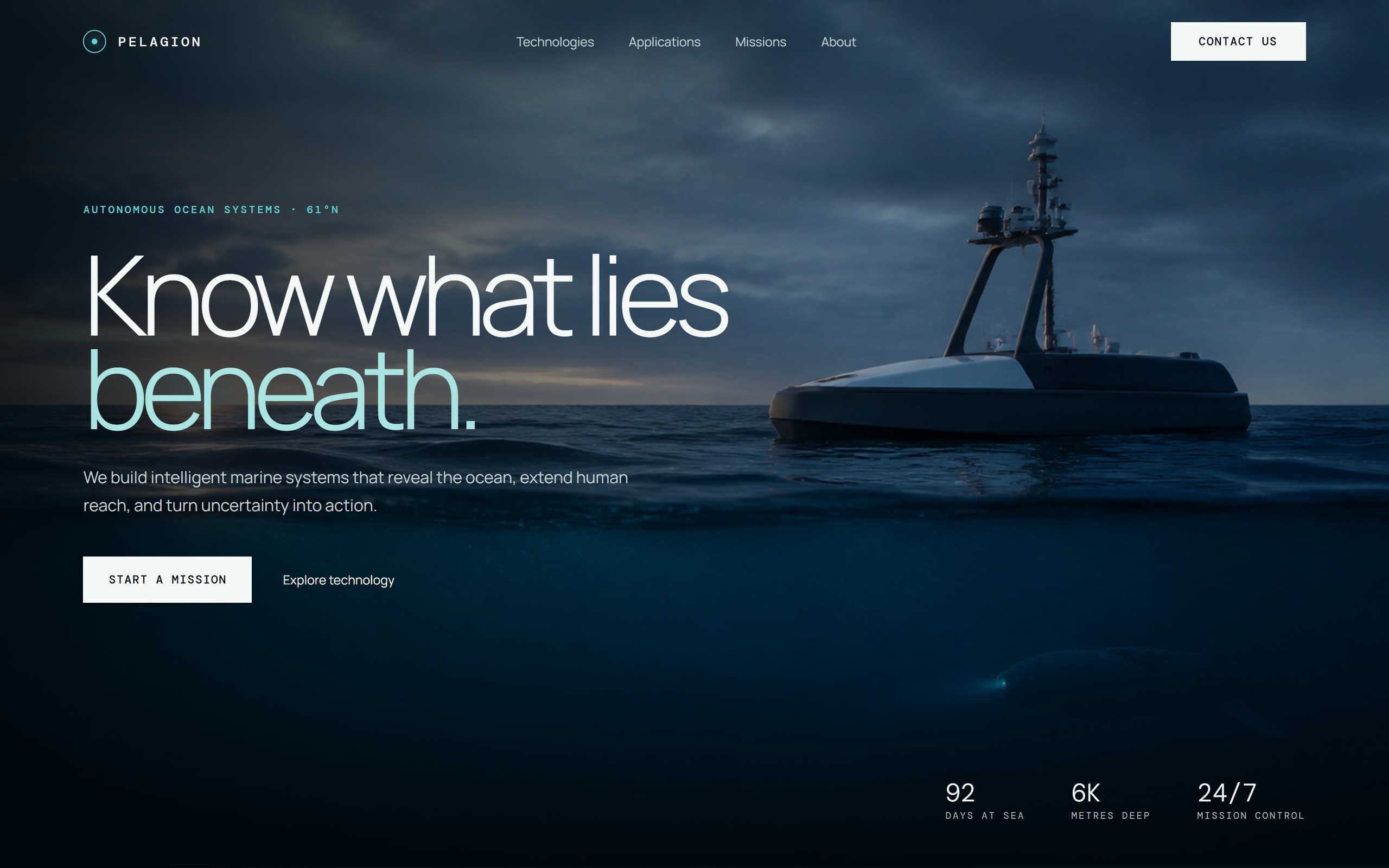
Autonomous marine systems, oceanographic sensors and mission software — one story across hardware and the software that flies it.
- Website
- Product
- Hardware + software
- Industry
- Marine technology
- Engagement
- 8 weeks
- Team
- 1 designer · 1 engineer
- Platforms
- Marketing site · Product pages · Technical specifications
01
Challenge
Pelagion sells hardware, sensors and software as one capability, to buyers who evaluate each of those things differently. A site organised by product line would have hidden the thing that makes the company credible: that the three are designed together.
The audience is technical and the claims are operational — decisions at sea, in conditions where a wrong reading has consequences — so the register had to be sober without being dull.
- Portfolio
- Autonomous systems · sensors · mission software
- Audience
- Technical and operational buyers
- Claim
- Safer, clearer decisions at sea
02
Solution
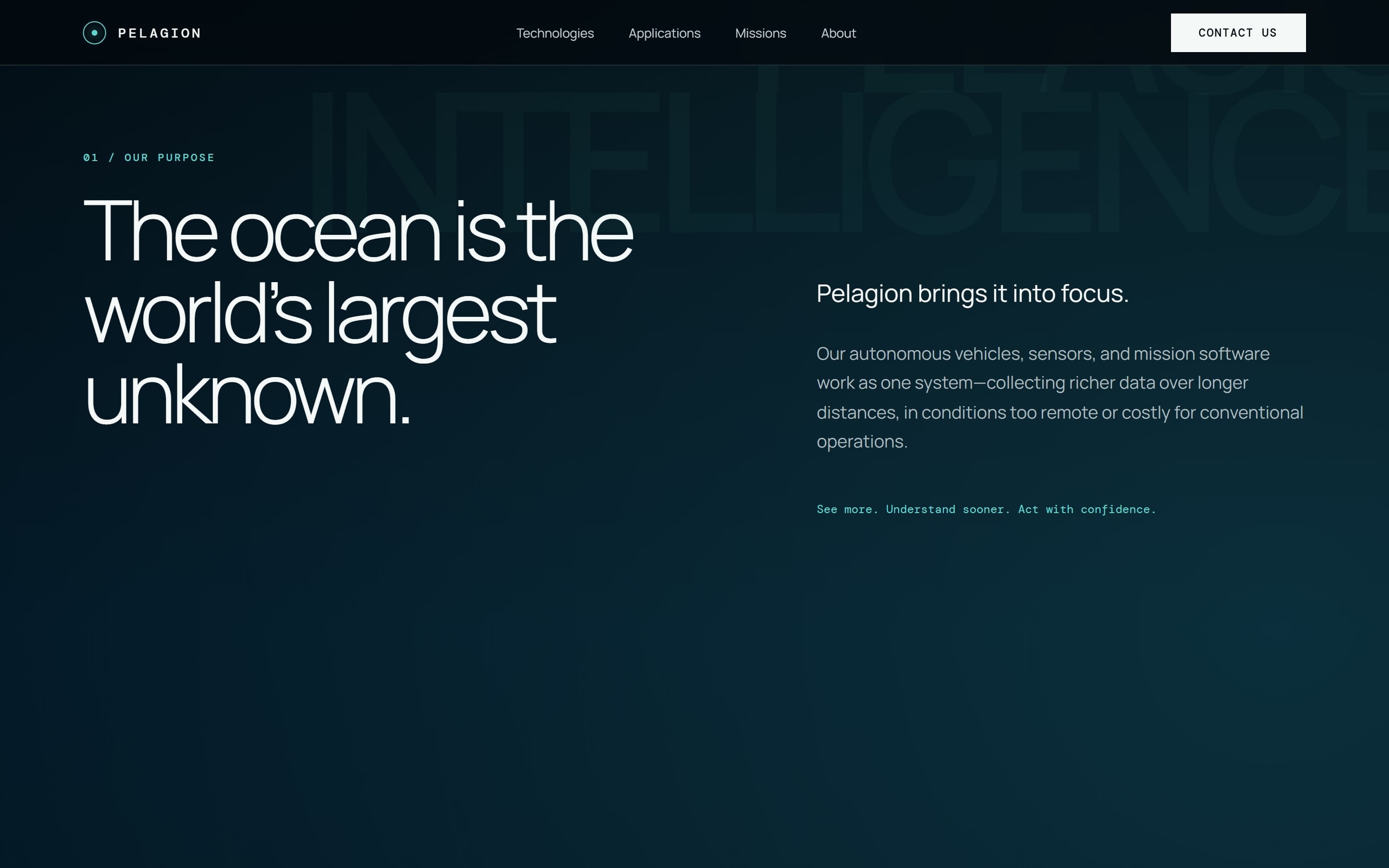
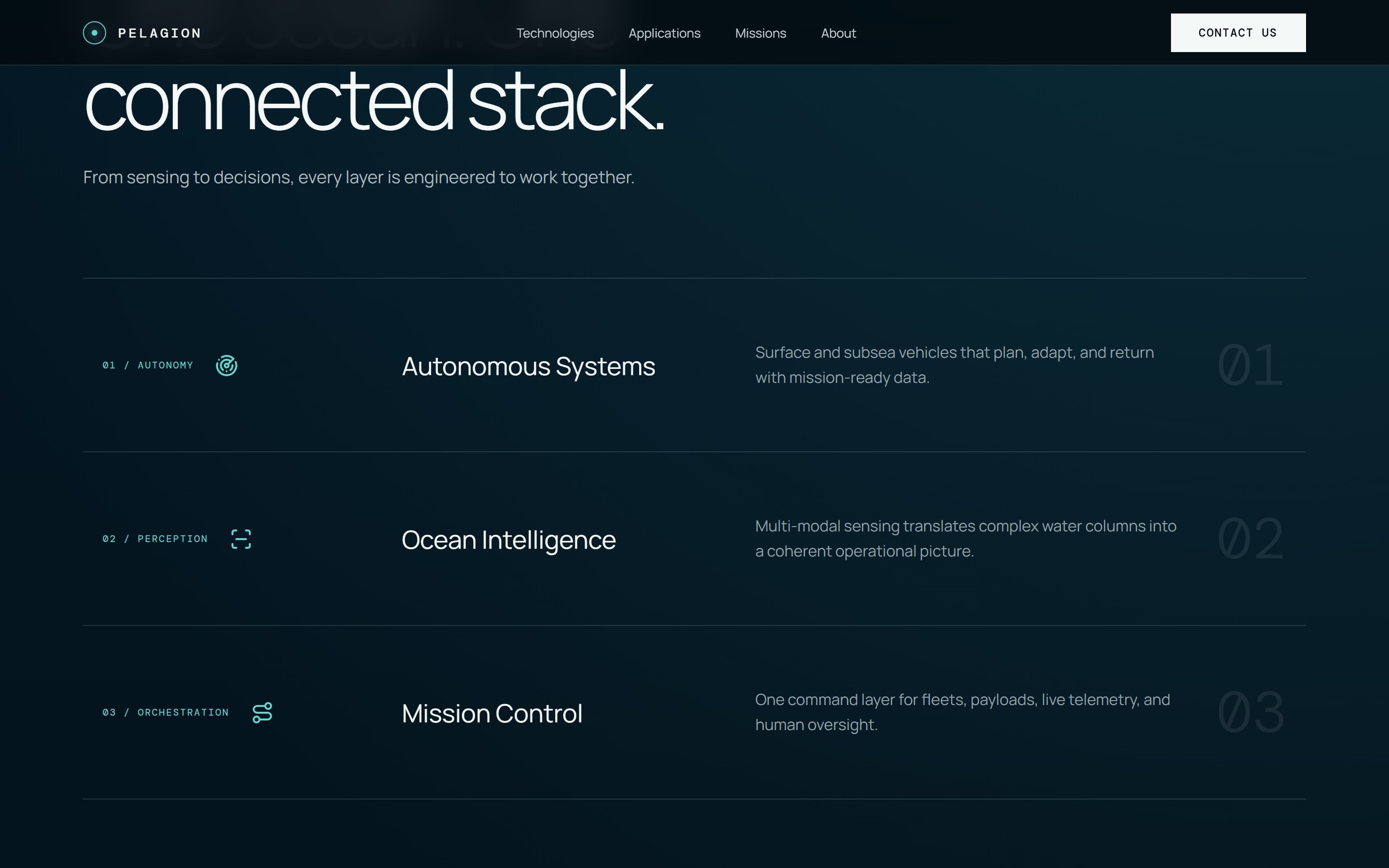
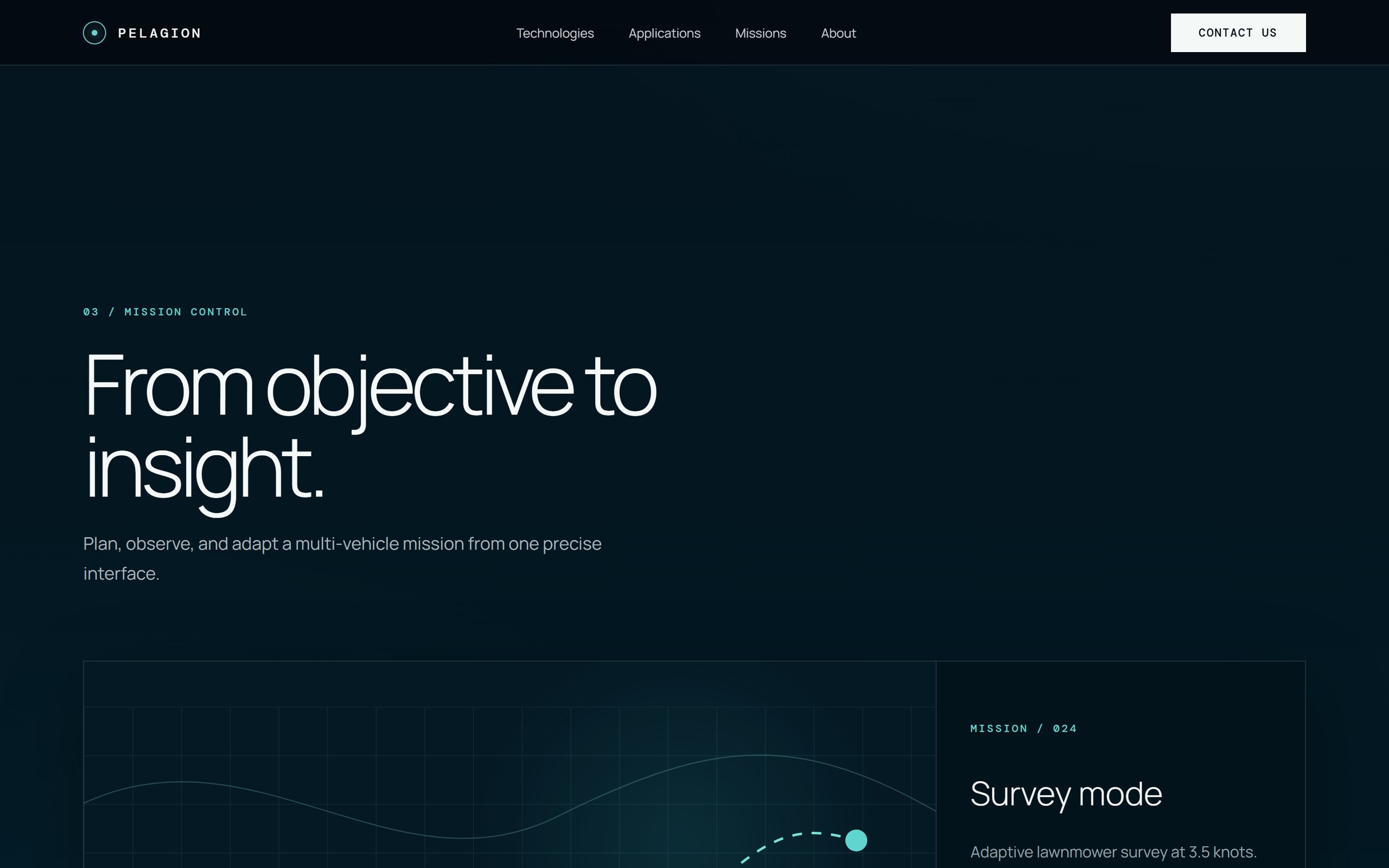
The site is organised by mission rather than by product line: what you are trying to find out, and which combination of platform, sensor and software answers it.
Specifications are treated as a designed surface rather than a PDF — comparable, scannable and linkable — because in this market the spec table is the sales material.
- Organising axis
- Mission, not product line
- Specifications
- Designed, linkable, comparable
03
Architecture
- L0SiteStatic
- L1Product modelPlatforms · sensors · softwareSpecification modelComparable fields
- L2Generated pagesServiceEnquiryService
- L3Email / CRMExternal
Connections (6)
- Site → Product model
- Product model → Specification model
- Product model → Generated pages
- Specification model → Generated pages
- Generated pages → Enquiry
- Enquiry → Email / CRM
04
UX
A visitor can enter from the mission, the platform or the sensor and reach the same coherent set of pages — the relationships between entities are modelled, so navigation never dead-ends at a leaf.
Technical detail is progressive: an operational summary first, full specification one interaction away, never both competing for the same screen.
05
UI
Cold, precise and high contrast, with imagery given full width and typography kept tight around it.
Specification tables use tabular figures and consistent units so two products can be compared by eye without a converter.
06
Development
Products, sensors and software are separate content models with explicit relations, so a new platform automatically appears everywhere it is relevant.
Fully statically generated with optimised imagery — the site is heavy on photography and still has to load on a ship's connection.
07
What it does
Mission-led navigation
Enter by what you need to find out, not by product line.
Related product model
Platforms, sensors and software modelled as connected entities.
Designed specifications
Comparable, scannable and individually linkable spec surfaces.
Progressive detail
Operational summary first, full specification on demand.
Optimised imagery
Heavy photography delivered at usable weights.
08
Integrations & stack
Integrations
- Email / CRM enquiry routing
- Analytics
Frontend
- Next.js
- TypeScript
- Tailwind CSS
- next/image
Platform
- Static generation
- Image optimisation
- CDN
09
Where it landed
- Mission-led
- Organising axis
- Related
- Entity model
- Linkable
- Specifications
- Static + optimised media
- Delivery
A new platform propagates automatically
The spec table is the sales material
Hardware, sensors and software read as one capability, which is the actual product Pelagion sells.
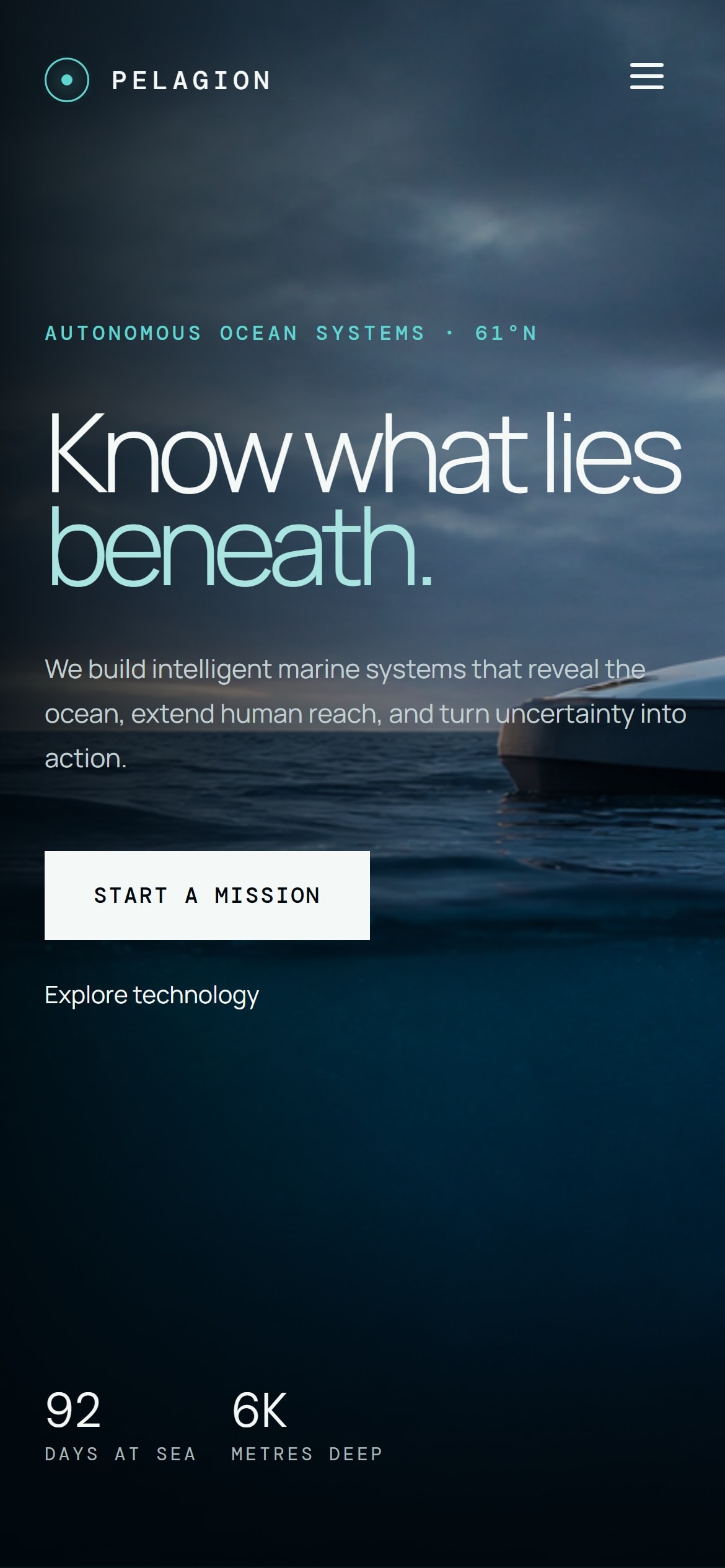
Every build is designed for the phone as its own experience, not as a narrowed desktop layout.
Got a product that should exist by now?Tell us about it.
Describe what has to change in your business. We will work out what that actually takes — including when it takes less than you think.